Ford Motor said Monday it will take a $19.5 billion writedown and is killing several electric-vehicle fashions, in the most dramatic instance yet of the auto industry’s retreat from battery-powered fashions in response to the Trump administration’s insurance policies and weakening EV demand.
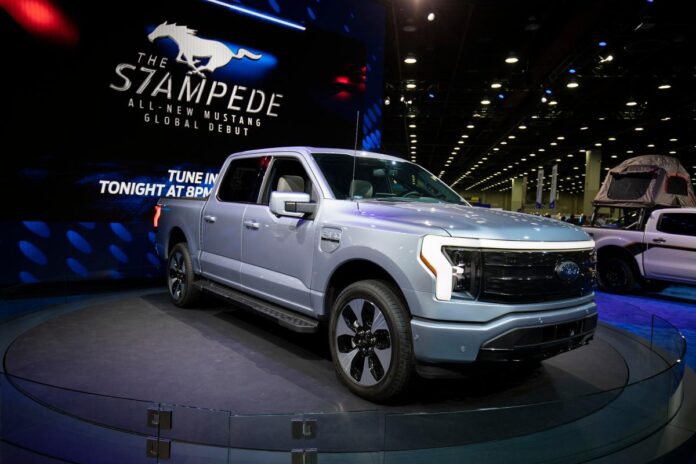
The Dearborn, Mich.-based company said it will stop making the F-150 Lightning in its electric vehicle type, but will pivot to producing an extended-range electric model, a model of a hybrid vehicle called an EREV, which makes use of a gas-powered generator to recharge the battery. The company is also scrapping a next-generation electric truck, codenamed the T3, as nicely as deliberate electric business vans.
Instead, Ford said it will pivot onerous into gasoline and hybrid fashions, and finally rent hundreds of employees, even though there will be some layoffs at a collectively owned Tennessee battery plant in the close to time period. The company expects its international combine of hybrids, extended-range EVs and pure EVs to attain 50% by 2030, from 17% right this moment.
Ford said it will stop making the F-150 Lightning in its electric vehicle type, but will pivot to producing an extended-range electric model Getty Images
Ford will unfold out the writedown, taken primarily in the fourth quarter and persevering with through next 12 months and into 2027, the company said. About $8.5 billion is associated to canceling deliberate EV fashions. Around $6 billion is tied to the dissolution of a battery three way partnership with South Korea’s SK On, and $5 billion on what Ford called “program-related expenses.”
The automaker also raised its 2025 steering for adjusted earnings before taxes and curiosity, to about $7 billion, up from a earlier vary of $6 billion to $6.5 billion.
Ford’s shift displays the auto industry’s response to waning demand for battery-powered fashions, after car firms plowed a whole bunch of billions of {dollars} into EV investments early this decade. The outlook for electrics dimmed considerably this 12 months as President Trump’s insurance policies yanked federal support for EVs and eased tailpipe-emissions guidelines, which could encourage carmakers to promote more gas-powered vehicles.
US gross sales of electric autos fell about 40% in November, following the September 30 expiration of a $7,500 shopper tax credit, which had been in place for more than 15 years to stoke demand. The Trump administration also included in the large tax and spending invoice that handed in July a freeze on fines that automakers pay for violating fuel-economy laws.
“Rather than spending billions more on large EVs that now have no path to profitability, we are allocating that money into higher-returning areas,” said Andrew Frick, head of Ford’s gasoline and electric-vehicle operations.
The F-150 Lightning rolled off meeting strains beginning in 2022 with much fanfare – comic Jimmy Fallon wrote a music about the truck. Ford elevated manufacturing of the model to meet an inflow of 200,000 orders, but gross sales haven’t stored tempo. The company bought 25,583 Lightnings through November of this 12 months, a 10% lower from the prior-year period.
The successor to the F-150 Lightning, the T3 truck, was supposed to be constructed ground-up for manufacturing at a new advanced in Tennessee, and be a core half of Ford’s second-generation EV lineup. Ford is now changing manufacturing of the EV pickup with new gas-powered vehicles beginning in 2029 at the Tennessee manufacturing facility.
Ford successfully killed the entirety of its announced second-generation of EV fashions with Monday’s announcement. For its future EV lineup, the company is shifting focus to more inexpensive EV fashions, conceived by a so-called skunkworks workforce in California. The first model from that workforce is slated to be priced at about $30,000 and go on sale in 2027. This midsize EV truck is being constructed at Ford’s Louisville plant.